
Opinion/Commentaries
Moral Authority or Political Theatre? Why the Anti-Amupitan Chorus Rings Hollow

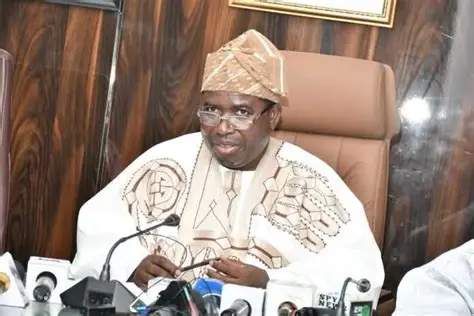
In Nigeria’s ever-dramatic political arena, outrage is cheap, virtue is often performative, and calls for resignation have become the new currency of relevance. The latest spectacle? A coalition of familiar voices—Professor Pat Utomi, Barrister Femi Falana (SAN), Dr Oby Ezekwesili, Comrade Ayuba Wabba, and others—demanding the resignation of INEC Chairman, Professor Joash Ojo Amupitan.
At first glance, the call by the so-called Movement for Credible Elections (MCE) may appear noble. Scratch beneath the surface, however, and it begins to look less like a principled stand and more like a carefully staged political drama—one that raises more questions about the accusers than the accused.
The Curious Case of Selective Outrage
Let us begin with the central allegation: that Professor Amupitan is unfit to lead the Independent National Electoral Commission due to supposed “digital footprints” suggesting partisan leanings.
But here’s the inconvenient truth: even if such a claim were valid—and that remains unproven—it is rooted in a past expression allegedly made years before his appointment. Are we now to pretend that Nigerians, before assuming public office, are not entitled to private opinions?
This is a dangerous precedent.
If every Nigerian who has ever expressed a political preference is automatically disqualified from public service, then the country might as well shut down its institutions. Judges, professors, civil servants—who among them has never held a political view?
The real question is not whether Amupitan once had an opinion. It is whether, in office, he has acted with bias. And on that score, his critics have presented no concrete evidence—only speculation dressed as digital mystique.
Who Are the Accusers?
Now to the more uncomfortable question: who exactly is calling for Amupitan’s head?
Take Pat Utomi, for instance. A man long celebrated for intellectual brilliance, yet whose political journey has been marked by inconsistency. Nigerians have not forgotten his flirtations across political platforms, nor how he stepped back rather conveniently during the Labour Party’s presidential race in 2023. At a critical moment that demanded courage and clarity, Utomi chose retreat.
Is this the same voice now demanding accountability?
And what of his past association with Volkswagen Nigeria? The controversies surrounding corporate governance during that era hardly place him on an untouchable moral pedestal. When a man’s own record invites scrutiny, he should tread carefully before casting stones.
Then there is Femi Falana, a Senior Advocate of Nigeria whose legacy as a defender of justice has earned him national respect. Which is precisely why his inclusion in this chorus is so disappointing.
Falana has, over decades, positioned himself as one of Nigeria’s most consistent voices of reason. Yet, in this instance, he appears to have lent his name to a cause built more on conjecture than evidence. One would have expected a legal mind of his stature to insist on proof, due process, and constitutional clarity—not to endorse what increasingly looks like a trial by public opinion.
The question must be asked: what changed?
A Coalition Without Credibility?
The MCE’s argument hinges on “integrity” and “public confidence.” Fine ideals—until one examines the track records of those invoking them.
Dr Usman Bugaje, a perennial political actor with shifting allegiances. Comrade Ayuba Wabba, whose tenure in labour leadership saw mixed outcomes for Nigerian workers. Dr Oby Ezekwesili, a respected reform advocate, yet one whose political interventions have often failed to translate into tangible electoral success.
Individually, they may have their merits. Collectively, however, they do not form an unimpeachable tribunal of moral authority.
Rather, they resemble what Nigerians have come to recognise all too well: a coalition of influence seeking relevance in a heated political cycle.
The BVN-NIN Argument: Sophistry or Substance?
Perhaps the most theatrical aspect of the MCE’s claim is its reliance on digital traceability—BVN, NIN, device logs—as if governance were now a cybersecurity experiment.
Yes, digital forensics is real. But it is also governed by standards of evidence, chain of custody, and judicial interpretation. Throwing around technical buzzwords in a press statement does not magically transform suspicion into proof.
“In this digital age, denial is not a defence,” they say.
True. But neither is accusation a conviction.
Amupitan’s Credentials: The Overlooked Reality
Lost in the noise is the man at the centre of it all: Professor Joash Ojo Amupitan.
A respected legal scholar. A Senior Advocate of Nigeria. A former academic with decades of experience in constitutional law and governance. By every measurable standard, he possesses the intellectual and professional grounding required to lead an institution as critical as INEC.
More importantly, since assuming office, there has been no demonstrable act of bias, no compromised electoral process, no judicial indictment against him.
So what exactly is the rush?
Is Nigeria so devoid of due process that mere allegations—unproven, historical, and contextually weak—are enough to demand the resignation of a sitting INEC Chairman?
The Danger of Manufactured Crises
Let us be clear: the integrity of Nigeria’s electoral system is too important to be trivialised by politically convenient outrage.
If Professor Amupitan is guilty of misconduct, let evidence be presented. Let due process take its course. But to demand his resignation on the basis of speculative digital claims is to weaponise suspicion and undermine institutional stability.
Today, it is Amupitan. Tomorrow, it could be any public official whose past opinions are dredged up to serve present agendas.
Final Word: Let the Man Work
Nigeria stands on the threshold of another critical electoral cycle. What the country needs is not distraction, but focus. Not noise, but competence.
Professor Amupitan must be allowed to do his job—to organise, reform, and deliver elections that Nigerians can trust. If he fails, he should be held accountable. But until then, calls for his resignation are not only premature—they are profoundly unconvincing.
As for the self-appointed guardians of democracy, perhaps the time has come for introspection.
Because in the court of public opinion, credibility is not claimed—it is earned.
Kindly contact us @ info[@]wordspired.com.ng
Call or Whatsapp: +234 803 951 2443, +234 705 759 7144








2027: Oyewumi, Olaoluwa, Fadipe, other Accord Candidates Doubtful

Zamfara Assembly Stable, Functional Despite Defectors’ Distractions, Says Speaker Moriki

INEC Announces October 9 Start for Nationwide PVC Collection Ahead of 2027 Elections

INEC Sets Simultaneous Voting as Key Target for 2027 General Elections

Anambra Govt Accuses Obi of Undermining APGA, Urges Voters to Reject Him


 News6 years ago
Omar Bolaji Gambari: The new Mr. Fix It in Aso Rock?
 News7 years ago
You are in trouble, Shekau threatens Chadian President Idris Deby
- News6 years ago
Dutch top football league may be cancelled
- Entertainment6 years ago
Afro fusion act TYMZY set to excite music fans with debut collection
- Entertainment6 years ago
Saidi Balogun’s latest movie White/Funfun hits the market, making waves on YouTube
- News6 years ago
Maryam Onikijipa-Belgore: Living an Impactful Life for the Downtrodden
- News6 years ago
“Ego is the major problem affecting Yoruba race” – Oba Frederick Akinruntan
- Metro6 years ago
Super cop, Yinka Egbeyemi distributes COVID-19 palliatives, turns heat on Lagos hoodlums