
Opinion/Commentaries
OSUN ELECTION: Finally, INEC Becomes the Trusted Umpire — The Amupitan Effect


For years, elections in Nigeria have carried with them an almost predictable burden of anxiety, suspicion and uncertainty. Even after ballots had been cast and counted at polling units, Nigerians often remained apprehensive about what would happen between the polling unit and the final declaration.
The question was rarely simply who won? It was often will the result reflect what we voted for?
That atmosphere may finally be changing.
The evidence from three successive governorship elections conducted under the leadership of Professor Joash Ojo Amupitan as Chairman of the Independent National Electoral Commission (INEC)—Anambra in November 2025, Ekiti in June 2026 and now Osun on August 15, 2026—suggests that Nigeria’s electoral management may be entering a new phase in which transparency, technology, speed and institutional discipline can begin to replace the traditional culture of suspicion.
The emerging phenomenon could aptly be called the Amupitan effect.
It is not necessarily that elections have suddenly become perfect. They have not. There have been complaints, delays, isolated security incidents, allegations of vote-buying and political disagreements. But the more important development is that the electoral process appears increasingly capable of providing citizens with verifiable information quickly enough to reduce the space in which rumours and conspiracy theories traditionally flourish.
And nowhere has this been more evident than in the Osun governorship election.
FROM ANXIETY TO TRANSPARENCY
The significance of the development becomes clearer when one considers the historical experience of Nigerian elections.
In the past, the period between voting and the final declaration was often filled with tension. Political parties announced parallel results. Supporters gathered around collation centres. Social media became flooded with unverified figures. Allegations of manipulation multiplied.
By the time INEC eventually announced a winner, a large section of the public had already formed opinions about whether the result was credible.
The introduction and increasingly effective use of electronic result transmission have begun to alter that dynamic.
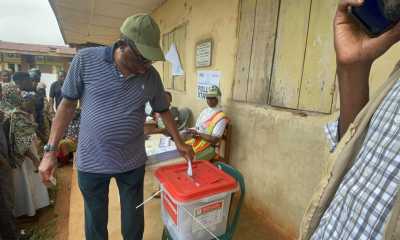
With polling-unit results uploaded to INEC’s Result Viewing Portal, IReV, Nigerians no longer have to depend entirely on whispers, party statements or unofficial tallies to understand the direction of an election.
The Osun election provided a particularly striking demonstration of this.
By 2:06 a.m. on Sunday, INEC had uploaded results from 3,612 of the state’s 3,763 polling units—95.99 per cent of the total. At that point, Ademola Adeleke of Accord was leading with 509,057 votes, compared with 425,879 for APC candidate Bola Oyebamiji, while ADC candidate Najeem Salaam had 17,393 votes.
Even before the final declaration, therefore, the broad direction of the election was no longer a mystery.
The numbers were visible.
The trend was visible.
The emerging winner was visible.
That is a major departure from the era when Nigerians had to wait anxiously for a central announcement before they could begin to understand what their votes had produced.
THE OSUN TEST
The 2026 Osun governorship election was hardly an easy environment for an electoral umpire.
The contest was intensely competitive. The incumbent governor, Ademola Adeleke of Accord, was seeking another term against the APC’s Bola Oyebamiji, while Najeem Salaam of the African Democratic Congress and candidates of other parties also participated.
The campaign period was marked by allegations and counter-allegations, concerns about political violence, vote-buying and intimidation.
On election day itself, INEC reported that 207 of the state’s 3,763 polling units experienced delays in opening, although the Commission said those units became operational by 9 a.m.
There were also reports of sporadic shootings and allegations of attacks and intimidation, although not all allegations were independently verified.
Yet the broader electoral process moved forward.
More importantly, the results began to tell their own story.
As the IReV uploads accumulated, it became increasingly difficult for political actors or commentators to create an entirely different narrative from the actual figures appearing on the Commission’s platform.
That is precisely where technology becomes more than a technical innovation. It becomes an instrument for public confidence.
THE BRICKBATS DID NOT DETERMINE THE RESULT
There was apprehension before the election.
There were political brickbats.
There were accusations from opposing camps.
There were concerns about whether the election would be free and fair.
But when the votes were counted, the numbers ultimately determined the outcome.
INEC’s final declaration gave Adeleke 511,067 votes against Oyebamiji’s 444,815, a margin of 66,252 votes. Adeleke won 19 of the state’s 30 local government areas, while Oyebamiji won 11.
The significance goes beyond the personality of the winner.
It is important because the incumbent governor was not simply declared winner behind closed doors. Nigerians watched the results emerge progressively through the electoral process, with polling-unit results being uploaded and collated.
By the time the final declaration came, the outcome was already apparent from the available figures.
That is what a trusted electoral umpire should ideally produce: an outcome that does not require Nigerians to suspend their disbelief before accepting it.
THE AMUPITAN EFFECT
Professor Amupitan assumed office in October 2025 at a particularly delicate moment for Nigerian democracy.
He was sworn in on October 23, 2025, after being nominated by President Bola Ahmed Tinubu and confirmed by the Senate.
His first major electoral test came barely 15 days after assuming office: the November 8, 2025 Anambra governorship election.
That election was widely regarded as an important test of whether the new chairman could quickly impose his administrative philosophy on an institution as complex as INEC.
It produced a decisive result.
Charles Soludo of APGA won 422,664 votes, defeating APC’s Nicholas Ukachukwu, who polled 99,445. Soludo won all 21 local government areas.
But perhaps more significant for the present discussion was the manner in which the process unfolded.
Amupitan himself later told political parties that the Commission had managed the Anambra election with openness, accountability and adherence to the law, and that the election was widely acknowledged as credible, inclusive, transparent and efficiently administered.
The election also demonstrated the value of electronic result transmission, allowing citizens and stakeholders to follow results without waiting exclusively for the final declaration.
EKITI: ANOTHER TEST, ANOTHER RESULT
If Anambra was the first major test, Ekiti became another opportunity to determine whether the apparent improvement was merely a coincidence.
It was not.
The June 20, 2026 Ekiti governorship election returned incumbent Governor Biodun Oyebanji of the APC for a second term.
INEC declared Oyebanji winner with 319,224 votes against PDP’s Wole Oluyede, who scored 40,543. Oyebanji won all 16 local government areas.
Again, the significance was not simply that an incumbent won.
It was that the electoral umpire successfully processed the contest, announced the results and subsequently issued certificates of return.
Oyebanji himself commended INEC, security agencies and electoral officials for what he described as their professionalism and commitment to a peaceful, free and credible election.
The pattern was becoming difficult to dismiss.
Anambra.
Ekiti.
Now Osun.
Three different political environments. Different candidates. Different parties. Different local dynamics.
But an increasingly similar experience of a result that became visible through the electoral process.
WHEN RESULTS SPEAK FOR THEMSELVES
There is a deeper democratic value in the rapid transmission of results.
When results are hidden from public view for too long, suspicion fills the vacuum.
When figures are available, independently observable and progressively updated, the space for speculation becomes narrower.
This is why the IReV portal matters.
In Osun, for example, when the Commission had uploaded 3,292 polling-unit results—87.48 per cent of the expected total—the emerging lead was already clear.
There was, however, a temporary interruption in uploads after that point, which generated fresh concerns. Adeleke’s campaign raised an alarm, while musician Davido also questioned the delay publicly. INEC subsequently resumed uploading the results.
That episode is important because it demonstrates that trust does not mean the public should stop asking questions.
Quite the opposite.
A credible electoral system should be transparent enough to withstand scrutiny.
And when there is a delay, the public should be able to see the process resume rather than being left entirely in the dark.
THE REAL AMUPITAN TEST IS BIGGER THAN THREE ELECTIONS
It would be premature to declare that Nigeria’s electoral problems are over.
They are not.
Technology cannot eliminate vote-buying.
It cannot by itself prevent political violence.
It cannot replace the integrity of polling officials, security agencies, political parties and candidates.
And IReV cannot substitute for the broader institutional reforms required to strengthen Nigerian democracy.
But technology combined with disciplined administration can make manipulation more difficult and accountability easier.
That is where Amupitan’s significance may ultimately lie.
His stated philosophy has been unequivocal. Upon assuming office, he committed the Commission to free, fair, credible, transparent and inclusive elections that reflect the will of Nigerians, while stressing that electoral credibility must be non-negotiable.
The question was whether those words would translate into practice.
So far, the evidence from the three major governorship elections conducted under his watch provides grounds for optimism.
THE CRITICS MAY HAVE GOT IT WRONG
Perhaps one of the most interesting dimensions of Amupitan’s tenure is the speed with which his critics moved against him.
In April 2026, the ADC called for his resignation, alleging partisanship. INEC rejected the demand, describing it as politically motivated and legally unfounded.
Those early attacks now deserve to be reconsidered against the record that has emerged.
Critics who initially questioned Amupitan’s pedigree, independence or resolve may have been too quick to reach their conclusions.
A Professor of Law, Senior Advocate of Nigeria and former university administrator, Amupitan came to INEC with a background steeped in law, governance and institutional administration.
What he appears to be demonstrating is that he understands the central principle upon which an electoral commission must operate:
The election does not belong to INEC. It belongs to the voters.
INEC’s responsibility is to create the conditions under which the voters’ choice can be accurately captured, transmitted, collated and declared.
The Osun election suggests that principle is beginning to translate into institutional practice.
FROM “WHO WILL INEC FAVOUR?” TO “WHAT DO THE RESULTS SAY?”
For generations, Nigerian political conversations around elections have often centred on the presumed preference of the electoral umpire.
Which candidate is INEC supporting?Which party has access to the Commission? Will the results be manipulated? Who will the returning officer declare?
That culture of suspicion is corrosive to democracy because it shifts attention away from the voters and towards the institution conducting the election.
The emerging Amupitan model could gradually reverse that psychology.
The more results are uploaded promptly, the more polling-unit figures become visible and the more transparent the collation process becomes, the less important speculation about INEC’s alleged preference becomes.
The question eventually becomes simpler: What did the voters say?
In Osun, the answer was ultimately clear. They voted. The ballots were counted. The results were transmitted. The results were collated. And INEC declared Ademola Adeleke the winner.
A NEW STANDARD FOR 2027?
The real significance of Anambra, Ekiti and Osun may therefore not lie in the individual winners.
It lies in the precedent being established ahead of Nigeria’s 2027 general election.
The 2027 election will be vastly larger, more complicated and politically consequential than any of these off-cycle governorship elections.
The pressure on INEC will be immense. The stakes will be higher. The political contest will be fiercer. The volume of misinformation will almost certainly be greater. That is why the lessons from these three elections matter.
If the Amupitan-led INEC can maintain the same commitment to transparent result transmission, technological deployment, timely communication, professional administration and adherence to electoral rules as the country moves towards 2027, Nigeria may be witnessing the beginning of a significant institutional reset.
But the Commission must also recognise that trust is earned gradually and can be lost quickly.
Every election must therefore be treated as another opportunity to strengthen public confidence.
THE TRUSTED UMPIRE
An umpire is trusted not because everyone likes the decisions made, but because everyone believes the rules are being applied fairly.
That distinction is critical.
A political party can lose an election and still accept the process if it believes the umpire was fair.
A candidate can be defeated and still congratulate the winner if the pathway to victory is transparent.
A voter can accept an outcome—even one that disappoints them—when they can see how the numbers were generated.
That is the real promise of the Amupitan effect. It is not that INEC will never make mistakes. It is not that there will never be complaints. It is not that every Nigerian will suddenly agree with every declaration.
Rather, it is the possibility that the electoral process itself can become sufficiently transparent that Nigerians no longer have to spend days wondering whether their votes have been transformed into something else before reaching the final result.
Osun may have provided the clearest demonstration yet.
Despite the tension, allegations, political brickbats and pockets of violence surrounding the election, the process produced a result that was increasingly visible in real time.
And when the final figures were announced, the winner reflected the direction that the publicly transmitted results had already indicated.
That is how confidence is built. That is how an electoral umpire earns credibility.
And that may ultimately be Professor Joash Ojo Amupitan’s most important contribution to Nigerian democracy so far: making Nigerians believe once again that the ballot box, rather than the backroom, can determine who wins an election.
If that trend continues into 2027, the story of Nigerian elections may begin to change from one of suspicion and anxiety to one of transparency, verification and acceptance.
The Amupitan effect is still a work in progress. But after Anambra, Ekiti and Osun, it is becoming increasingly difficult to dismiss it as mere coincidence.
Kindly contact us @ info[@]wordspired.com.ng
Call or Whatsapp: +234 803 951 2443, +234 705 759 7144














TAIWO BABATUNDE HASSAN: A Gentle Giant of the Screen, A Man Of The People, A Legacy That Will Endure

Subsidy Debate Deepens as FG, APC Reject Atiku’s 2027 Proposal

IBD Dende Mourns Passing of Actor Ogogo, Says Ilaro Has Lost One of Its Illustrious Sons

Aare Adetola Emmanuelking Celebrates Damola Aiyeola at 60, Applauds His Contributions to RSSOSA

Lawal Hails Yari’s Appointment as Tinubu/Shettima Campaign DG, Says Zamfara Is Proud


 News6 years ago
Omar Bolaji Gambari: The new Mr. Fix It in Aso Rock?
 News6 years ago
You are in trouble, Shekau threatens Chadian President Idris Deby
- Entertainment6 years ago
Afro fusion act TYMZY set to excite music fans with debut collection
- News6 years ago
Maryam Onikijipa-Belgore: Living an Impactful Life for the Downtrodden
- News6 years ago
Dutch top football league may be cancelled
- Entertainment6 years ago
Saidi Balogun’s latest movie White/Funfun hits the market, making waves on YouTube
- News6 years ago
“Ego is the major problem affecting Yoruba race” – Oba Frederick Akinruntan
- Metro6 years ago
Super cop, Yinka Egbeyemi distributes COVID-19 palliatives, turns heat on Lagos hoodlums