
Opinion/Commentaries
Gusau International Airport: Governor Dauda Lawal Deserves Accolades


By Oladapo Sofowora
On the 2nd of October, 2026, an XEJet aircraft lifted off from Abuja and touched down at Gusau International Airport. For the people of Zamfara, that moment had been thirty years in the making. This was no ordinary commercial flight launch; for a northwestern state that had never had an airport since its creation in 1996, it was long overdue. While many still lazily define Zamfara as a den of kidnappers, Governor Dauda Lawal has spent most of three years pouring concrete into a runway that tells a different story.
Before Gusau International Airport existed, anyone in Zamfara needing to fly had to endure hours on the road to Sokoto or Kano. For Muslims embarking on the Hajj pilgrimage to Saudi Arabia, that overland journey was itself an ordeal. For a state blessed with agricultural riches and mineral potential, the absence of an air corridor meant investors looked elsewhere, farm produce could not efficiently reach external markets and the movement of talent was shackled by sheer distance.
This isolation was not natural. It was the product of decades of governance failure. A previous administration had announced the airport’s construction in 2019, claiming a $1 billion public-private partnership would deliver it. By the time Lawal took office in May 2023, what remained was a graveyard of unfinished concrete and a financial record clouded in opacity. Governor Lawal inherited not just an abandoned project but a treasury hollowed out by years of mismanagement and lack of foresight.
In June 2024, construction restarted and by March 2026, a Federal Government Bombardier Challenger 605 completed a historic test flight at Gusau International Airport, confirming that the runway, navigation aids and ground handling systems met airworthiness standards which was met with commendation from the aviation industry players.
It was a timeline compressed to its limits. In Nigeria, a state-level airport project typically takes years, sometimes over a decade, from conception to operation. Lawal’s team did it in under two years of hard work. More significant is the technical validation. Official records show Gusau International Airport became the only airport in Nigeria to pass all 17 International Civil Aviation Organisation quality assurance steps. That detail may escape the average traveller but it means this is not a vanity project dressed up for ribbon-cutting photographs. It is infrastructure built to international specifications.
On the 15th of May, 2026, the first Hajj flight departed from Gusau, carrying 415 pilgrims on a Max Air aircraft directly to Saudi Arabia. At the inaugural ceremony, Lawal said many people doubted whether this could become a reality. That sentence captured the story of a state that had been underestimated for far too long, finally proving its doubters wrong. Critics asked, does a state with stubbornly high poverty rates really need an international airport?
That question ignores the most basic causal relationship between infrastructure and economic development. Zamfara’s agricultural potential has been strangled by transport bottlenecks for decades. The state produces hibiscus, sesame seeds, groundnut seeds, cotton seeds, Sorghum (Guinea Corn) & Millet precisely the commodities in high demand in international markets. But without air cargo links and efficient logistics, farmers sell raw materials cheaply to middlemen while the bulk of the profit flows elsewhere. Lawal with an investment banker background understands that what he is building is not just an airport but an ecosystem.
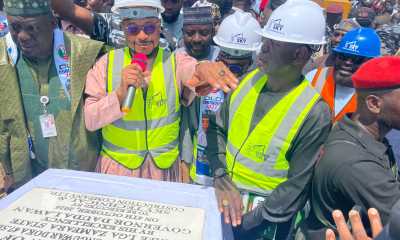
On the 21st of September, 2026, the Zamfara State Government signed an air route development agreement with XEJet, establishing regular commercial flights between Gusau and Abuja, operating Bi-weekly. On the 2nd of October, 2026, two days after commercial flights began, he flagged off a 95-kilometre road project in Tsafe Local Government Area. The road, connecting farming communities like Yandoton Daji, Cediya and Doka, includes five bridges. Its purpose is unambiguous; let farm produce out, let security forces in.
“When roads connecting farmlands are motorable, the heavy machinery we procured can reach the fields,” Lawal said at the groundbreaking. “After harvest, agricultural produce can move smoothly to markets.” Governor Lawal Said.
This is not an isolated project; it’s a coherent chain, the airport opens external gateways, the roads open internal circulation and together they transform the deadlock of “farmers can grow but cannot sell” into a living economy where produce moves, markets expand and money stays in local pockets.
On the surface, this is a simple route. Symbolically, it is a rupture. It means Gusau is no longer a dot on the map that requires a gruelling journey to reach. It is a destination accessible from the capital in about an hour. For investors, the decision cost of travelling to Gusau drops from a full day on the road to a short 40-minute flight from Abuja. For civil servants, traders, students and patients, this route redraws the boundaries of what is possible in daily life.
The airport terminal offers free internet access. Lawal’s team clearly intends for Gusau to be connected not only physically to the national grid of transportation but digitally to the networks of the knowledge economy. In a state seeking to nurture IT talent and attract tech-enabled businesses, connectivity is not a luxury; it is the foundation.
What the airport represents is a shift in trajectory a proof that Zamfara can conceive, execute and complete a project of national significance within a single political term.
In years to come, when Zamfara farmers are exporting hibiscus, sesame and other agricultural produce directly to buyers in Europe and the Middle East, when investors are flying in for meetings rather than avoiding the state altogether, when a young person from Gusau can board a flight to Abuja for a job interview and return the same day, the true value of this airport will become apparent.
Starting and finishing a project of that magnitude in under three years is the mark of a government serious about development at every level. Governor Lawal deserves the accolades. More importantly, the people of Zamfara deserve the future this runway has opened for them. The rescue mission is not complete; the planes are flying, for a state that spent three decades grounded, this development is nothing short of a revolution.
Kindly contact us @ info[@]wordspired.com.ng
Call or Whatsapp: +234 803 951 2443, +234 705 759 7144











Gusau International Airport: Governor Dauda Lawal Deserves Accolades

Adeleke Jettisons Accord Party National Assembly Seats

Saidi Balogun Applauds Appointment of Shehu Abdullahi, Kenneth Omeruo to City Boy Sports Directorate

Tinubu Inaugurates APC 2027 Campaign Council, Urges Unity, Focus on Governance

Tinubu Says World Bank Report Validates Economic Reforms, Points to Poverty Stabilisation


 News6 years ago
Omar Bolaji Gambari: The new Mr. Fix It in Aso Rock?
 News7 years ago
You are in trouble, Shekau threatens Chadian President Idris Deby
- News6 years ago
Dutch top football league may be cancelled
- Entertainment6 years ago
Afro fusion act TYMZY set to excite music fans with debut collection
- Entertainment6 years ago
Saidi Balogun’s latest movie White/Funfun hits the market, making waves on YouTube
- News6 years ago
Maryam Onikijipa-Belgore: Living an Impactful Life for the Downtrodden
- News6 years ago
“Ego is the major problem affecting Yoruba race” – Oba Frederick Akinruntan
- Metro7 years ago
Super cop, Yinka Egbeyemi distributes COVID-19 palliatives, turns heat on Lagos hoodlums