
Opinion/Commentaries
Crown, Crowned, or Contested? The Alli Paradox and Oyo’s Political Fault Lines


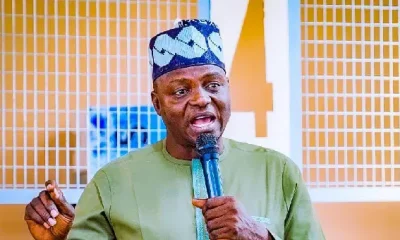
In Oyo State, where history breathes through tradition and power is often negotiated between modern politics and ancient institutions, the emerging governorship ambition of Sharafadeen Abiodun Alli has ignited a complex debate—one that sits uneasily at the intersection of culture, legitimacy, and political strategy.
At the heart of the controversy is not just his reported emergence as a preferred candidate of the All Progressives Congress (APC), but the deeper cultural implications of his recent elevation within Ibadan’s traditional hierarchy—an elevation that, by long-standing Yoruba customs, demands a withdrawal from partisan politics.
A Crown Beyond Ceremony
In Ibadanland, the conferment of a beaded crown is no ordinary honour. It is a transition into a sacred custodial role—one that elevates the recipient above the fray of everyday political contestation. When Alli was elevated to this status, it symbolised not merely recognition, but a transformation into a unifying figure expected to embody neutrality, wisdom, and cultural guardianship.
Yet, even before the echoes of that transition settled, reports began to gather momentum that the senator had been “handpicked” for the 2027 governorship race. For many observers, this dual positioning—traditional authority and partisan ambition—has created what is increasingly described as an “anomaly.”
The controversy deepened with reports that his crowning ceremony, organised with the involvement of the Oyo State Government, took place in absentia—an unusual development that has fueled speculation about underlying tensions within the traditional institution itself.
Attention has particularly turned to Oba Rashidi Adewolu Ladoja, the Olubadan of Ibadan, whose absence from the ceremony has been widely interpreted as more than coincidental. In political and cultural circles, it is alleged that the Olubadan tactically distanced himself, avoiding direct endorsement of a process many believe blurs the line between tradition and politics.
Tradition Versus Ambition
Yoruba tradition is unambiguous on one point: holders of beaded crowns are expected to rise above partisan divides. They are custodians of heritage, arbiters of peace, and symbols of communal unity. Their authority rests not in electoral mandates, but in moral and cultural legitimacy.
To step into the arena of competitive politics—especially one as divisive as a governorship race—risks undermining that neutrality. It raises questions not just about personal ambition, but about institutional integrity.
For many in Ibadan and across Oyo State, this is the crux of the issue. It is not necessarily about Alli as an individual, but about the precedent his actions could set. If traditional rulers—or those elevated into their ranks—actively pursue political power, what then becomes of the sacred distance that gives the institution its authority?
The Politics of Imposition
Beyond the cultural debate lies a familiar political undercurrent—one that has haunted the APC in Oyo State for years. Reports of Alli’s “anointed” status have revived memories of past electoral miscalculations, particularly the widely criticised candidate selection processes of 2019 and 2023.
Within party circles, there is growing unease that the APC may once again be drifting toward a pattern of imposition—selecting candidates behind closed doors, only to attempt reconciliation after the fact.
The circulation of a purported 2027 candidate list, projecting Alli as governorship flagbearer, has only intensified these concerns. Whether authentic or not, its impact is real: it reinforces the perception that decisions are being made without broad consultation.
Political observers warn that this “pick first, beg later” approach has consistently weakened the party’s electoral prospects in the state. The fallout from the 2023 governorship race—marked by internal divisions and half-hearted reconciliation—remains fresh in public memory.
As one analyst put it, reconciliation after imposition is often “a performance for the cameras,” lacking the genuine cohesion required to win elections.
Public Sentiment and Political Reality
Across Oyo State, there is a palpable sense of scepticism about Alli’s potential candidacy. Among party faithful and the broader electorate, many believe the APC risks repeating its past mistakes if it proceeds with what is perceived as a predetermined outcome.
The concern is not merely about electability, but about legitimacy. In a politically conscious state like Oyo, where grassroots mobilisation and internal unity are critical, any candidate seen as imposed carries a significant burden into the general election.
For a party seeking to reclaim power from Governor Seyi Makinde, the stakes are high. The lesson from previous elections is clear: division within the ranks can be more damaging than opposition strength.
Between Two Thrones
Sharafadeen Alli now finds himself straddling two powerful but potentially incompatible worlds—traditional authority and partisan politics. Each comes with its own expectations, obligations, and limitations.
The beaded crown demands restraint, neutrality, and cultural stewardship. The governorship race demands ambition, strategy, and political contestation. To attempt both simultaneously is to invite scrutiny from all sides.
The question confronting Oyo State is not just whether Alli can navigate this delicate balance, but whether the system itself can accommodate such a dual role without eroding its foundational values.
A Test for Institutions
Ultimately, the unfolding situation is a test—of tradition, of political maturity, and of institutional boundaries.
For Ibadan’s traditional system, it is a moment to reaffirm the principles that have sustained it for generations. For the APC, it is an opportunity to decide whether it will embrace inclusive, credible processes or repeat a cycle that has proven costly.
And for Sharafadeen Alli, it is perhaps the most defining moment of all: a choice between two paths, each carrying its own form of legacy.
In a state where history is never far from the present, that choice may well determine not just a political future, but the preservation of a cultural heritage that many believe must remain above politics.
Kindly contact us @ info[@]wordspired.com.ng
Call or Whatsapp: +234 803 951 2443, +234 705 759 7144








TAIWO BABATUNDE HASSAN: A Gentle Giant of the Screen, A Man Of The People, A Legacy That Will Endure

Subsidy Debate Deepens as FG, APC Reject Atiku’s 2027 Proposal

IBD Dende Mourns Passing of Actor Ogogo, Says Ilaro Has Lost One of Its Illustrious Sons

Aare Adetola Emmanuelking Celebrates Damola Aiyeola at 60, Applauds His Contributions to RSSOSA

Lawal Hails Yari’s Appointment as Tinubu/Shettima Campaign DG, Says Zamfara Is Proud


 News6 years ago
Omar Bolaji Gambari: The new Mr. Fix It in Aso Rock?
 News6 years ago
You are in trouble, Shekau threatens Chadian President Idris Deby
- Entertainment6 years ago
Afro fusion act TYMZY set to excite music fans with debut collection
- News6 years ago
Maryam Onikijipa-Belgore: Living an Impactful Life for the Downtrodden
- News6 years ago
Dutch top football league may be cancelled
- Entertainment6 years ago
Saidi Balogun’s latest movie White/Funfun hits the market, making waves on YouTube
- News6 years ago
“Ego is the major problem affecting Yoruba race” – Oba Frederick Akinruntan
- Metro6 years ago
Super cop, Yinka Egbeyemi distributes COVID-19 palliatives, turns heat on Lagos hoodlums