
Opinion/Commentaries
TAIWO BABATUNDE HASSAN: A Gentle Giant of the Screen, A Man Of The People, A Legacy That Will Endure

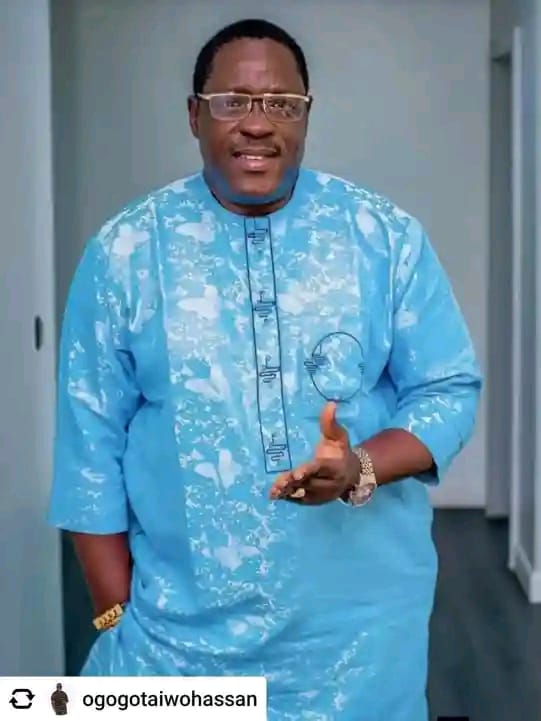
By: Timothy Enietan-Matthews
There are some deaths that leave you searching for words.
There are some departures that make you pause, look back at the journey of the departed and ask whether the end could really have come so soon.
The passing of Alhaji Taiwo Babatunde Hassan, popularly known as Ogogo, is one of those painful moments.
He died on Sunday, August 23, 2026, at the age of 66, after a battle with cancer, and was laid to rest today, Monday, August 24, in his hometown of Ilaro, Ogun State, according to Islamic rites. His burial followed a Janazah prayer at the Asade Agunloye Pavilion Ground, after which his remains were committed to the earth. Reports from the burial described an outpouring of grief from colleagues, friends, admirers and members of the community.
And so, Nigeria’s Yoruba film community has lost one of its most recognisable faces, one of its most enduring performers and, more importantly, one of its most loved human beings.
Ogogo was not merely an actor. He was a presence.
He was the kind of performer whose appearance on screen immediately demanded attention. He did not need to shout to command a scene. He did not need exaggerated gestures to communicate authority. There was something about his carriage, his voice, his composure and the conviction with which he interpreted his roles that made him difficult to ignore.
For decades, he brought characters to life with an uncommon understanding of the emotional and cultural texture of Yoruba society.
But beyond the screen was a man who was deeply connected to his people.
A man who was loved.
A man who was respected.
A man whose journey from Ilaro to the heights of the Nigerian film industry represented much more than personal success.
It was a story of perseverance, talent, reinvention and service.
From Ilaro to the National Stage
Taiwo Babatunde Al-Hassan was born on October 31, 1959, in Ilaro, Ogun State. Available biographical accounts trace his early education to Ilaro and Lagos before he proceeded to technical training at Yaba, where he developed skills in automobile engineering/mechanics.
His was therefore not a story of a young man who simply woke up one morning and became a movie star.
Before the cameras and the red carpets came a different life.
He worked with the Lagos State Water Corporation, remaining there for years before eventually leaving in 1994 to pursue acting full-time. In an earlier interview, Hassan himself said he had been an actor since 1981 and had trained under the tutelage of Awo Ademola Fabunmi.
That decision required courage.
To leave the relative security of formal employment and commit oneself fully to the uncertainties of acting was no small decision.
But Ogogo believed in the craft.
And he stayed with it.
For more than four decades, he remained connected to the industry he loved.
The Birth of Ogogo
The name Ogogo eventually became bigger than a stage name.
It became a brand.
It became a familiar identity in Yoruba cinema.
It became a name that audiences across Nigeria and beyond associated with quality acting, culture, authority and memorable storytelling.
His rise coincided with the period when Nigerian home video and Yoruba-language cinema were expanding rapidly.
He became part of a generation that helped transform Yoruba theatre traditions into a modern screen industry.
He also worked closely with fellow veterans, including Yinka Quadri, with whom he was associated with the Odunfa Caucus, a collective that became significant within the Yoruba film community.
In an interview published by The Guardian, Hassan explained that the group was created to pool resources and talents and support members in their creative pursuits. He said:
“We felt that we could pull resources, not just money, but our talents, to make a difference.”
That statement captures something important about the man.
Ogogo understood that an industry could not be built by one person alone.
He understood the value of collaboration.
He understood friendship.
He understood mentorship.
And he understood that people who rose together had a responsibility to help others rise.
The Performance that Changed Everything
Ogogo’s career was already developing before he became a household name, but his performance in Tade Ogidan’s Owo Blow marked a major turning point.
The film, released in the 1990s, exposed his talent to an even wider audience, and his performance earned him the Best Actor award at the 1997 edition of THEMA.
From that point, his face became increasingly familiar across Nigerian homes.
His screen presence was remarkable.
He had the rare ability to project strength without losing humanity.
He could play the traditional authority figure, the respected elder, the lover, the family man, the man of power, the troubled character and the morally complex individual.
And he could do so without losing the authenticity that audiences associated with him.
His performances were rarely mechanical.
They felt lived.
That was one of his greatest gifts.
A Career Built on Consistency
Over the years, Ogogo featured in numerous productions, including Owo Blow, Eyin Oka, Agbara Ife, 13th Day: Ojó Ketàlá, Arin Ota, Ase N Tedumare, Delicate Cane, Tears of Joy, Idajo Olorun, Legal Wife, Eleran Igbe, Ore Ijiji, Iya Ibeji and Ojo Ogbo.
His career also extended into production and later generations of Nigerian cinema.
He continued to demonstrate that age did not diminish talent.
In later years, audiences saw him in productions including Kunle Afolayan’s Aníkúlápó and its subsequent series, Aníkúlápó: Rise of the Spectre, where he played Alaafin Ademuyiwa.
This is significant.
At a time when the industry can sometimes become obsessed with youth and novelty, Ogogo remained relevant.
He adapted.
He evolved.
He continued to work.
And he continued to give audiences reasons to watch.
More Than an Actor
But if all we remember about Taiwo Hassan is his acting, then we have not told the complete story.
Ogogo was a man of the people.
His relationship with his hometown of Ilaro was particularly significant.
His love for his community was not merely expressed in words. In 2022, he was honoured by the Olu of Ilaro and Yewaland with the title of Otun Mayegun of Ilaro, in recognition of his contribution to the development of his hometown. Around the same period, he unveiled his Ogogo Estate real estate project in Ilaro, an initiative he had reportedly nurtured for years.
That chapter of his life tells us something about his ambitions beyond entertainment.
He wanted to build.
He wanted to create.
He wanted to leave something tangible behind.
He wanted his success to have meaning beyond himself.
And that is why his death hurts so much.
The Man Behind the Star
Those who knew Ogogo personally will remember another side of him.
The gentle man.
The conscientious man.
The man who could relate with ordinary people.
The man who did not allow his fame to completely separate him from the people from whom he came.
He was deeply loved within the industry because he was not simply a colleague.
He was a brother.
A friend.
A dependable presence.
A man whose journey was intertwined with the journeys of many other practitioners.
The tributes that have followed his death provide a glimpse of how widely he was regarded.
Even as his health deteriorated in his final days, colleagues came together in prayer for him. Reports before his death spoke of the deep concern among his family, friends, fans and colleagues, while an Islamic prayer session was organised by industry colleagues seeking divine intervention for his recovery.
That response was not accidental.
It was the reward of relationships built over many years.
A Devout Man
There was also a spiritual dimension to Ogogo’s life that deserves to be remembered.
He was a devout Muslim.
Reports from his burial in Ilaro today noted that the Chief Imam of the town praised him as a religious man who openly prioritised his faith, including while working on movie sets.
His final journey was therefore conducted in accordance with the faith he cherished.
There is something deeply poignant about that.
The actor who spent decades telling stories about life, struggle, love, family, power, morality and destiny has now become part of a story that belongs to all of us: the story of mortality.
The Tragedy of an Untimely Exit
Perhaps the most painful part of this loss is the timing.
At 66, Ogogo was still a man with so much ahead of him.
There was still so much building up around him.
There were still stories to tell.
Characters to interpret.
Younger practitioners to influence.
Projects to develop.
And dreams that were still taking shape.
He had not reached a point where one could say that everything he wanted to accomplish had been accomplished.
Far from it.
Death came at a moment when there was still so much life in the man.
That is why his departure feels particularly painful.
Cancer took him after a battle that generated enormous concern among those who loved him. Reports in the days before his death described his condition as serious and identified it as Stage 4 cancer.
We prayed.
His colleagues prayed.
His family prayed.
His admirers prayed.
But ultimately, as people of faith understand, there are matters beyond human control.
Inna lillahi wa inna ilayhi raji’un.
From Allah we came, and to Him we shall return.
But Death Did Not Wimn Everything
Yes, death has taken Ogogo.
But death did not take his legacy.
It did not take the memories.
It did not take the characters he created.
It did not take the lessons he passed on.
It did not take the young people he inspired.
It did not take the friendships he cultivated.
It did not take the contributions he made to Yoruba cinema.
It did not take the love he gave to his community.
And it certainly did not take away the indelible impression he left on Nigerian cinema.
That is the consolation available to those who mourn him.
He lived.
And he lived meaningfully.
A Legacy Beyond the Camera
The true measure of a person’s life is not necessarily the number of years spent on earth.
It is the number of lives touched.
By that measure, Taiwo Babatunde Hassan lived a rich life.
He touched audiences who watched him from their living rooms.
He touched colleagues who worked beside him.
He touched younger actors who watched his career and learned from his longevity.
He touched his hometown.
He touched friends.
He touched family.
He touched the broader Yoruba cultural space through a career that consistently placed indigenous language and culture at the centre of his artistic expression.
His career demonstrated that Yoruba cinema could produce actors capable of commanding national and international attention without abandoning the language, values and cultural identity that shaped them.
That is an important legacy.
The Industry Has Lost A Veteran
For those who spent decades in the movie industry, the passing of Ogogo is deeply personal.
They have watched generations come and go.
They have watched the industry evolve from stage performances and celluloid productions to home video, digital cinema, streaming platforms and global distribution.
Through those changes, Ogogo remained.
He was part of the bridge between the old and the new.
He belonged to a generation that laid foundations upon which today’s industry continues to build.
And that generation is gradually becoming smaller.
Each time one of these veterans leaves, we are reminded that the history of Nigerian cinema is not contained only in books and archives.
It is carried in people.
People like Ogogo.
People whose memories, experiences, sacrifices and contributions constitute the living history of the industry.
Goodbye Ogogo
Today, as the people of Ilaro commit his remains to the earth, the industry he served for more than four decades mourns.
But it won’t be right to remember Taiwo Babatunde Hassan only through the sadness of his final days.
Let us remember the smile.
Let us remember the voice.
Let us remember the confidence.
Let us remember the performances.
Let us remember the laughter.
Let us remember the friendships.
Let us remember the gentleman.
Let us remember the family man.
Let us remember the community man.
Let us remember the Muslim who cherished his faith.
Let us remember the actor who gave everything to his craft.
Let us remember the producer.
Let us remember the colleague.
Let us remember the man who became Ogogo and gave that name a meaning that will remain long after he has left us.
And let us remember that beneath the fame was simply a human being who wanted to live, work, create, love his people and leave the world a little better than he met it.
REST WELL, OGOGO
Our friend…
Our veteran…
Our man of the people…
Your final scene has come.
But your story has not ended.
It will continue in every film in which your face appears.
In every young actor who draws inspiration from your journey.
In every colleague who remembers your kindness.
In every Ilaro son or daughter who speaks proudly of the man their town produced.
And in every Nigerian who remembers the extraordinary screen presence of a man who spent more than four decades proving that genuine talent cannot be easily replaced.
You came from Ilaro.
You conquered the Nigerian screen.
You gave your people your talent.
You gave the industry your best years.
And you left behind a legacy that cannot be buried with you.
May Allah forgive your shortcomings.
May He accept your good deeds.
May He grant you Al-Jannah Firdaus.
May He comfort your family, friends, colleagues and the entire Ilaro community.
And may He give all of us the wisdom to learn from a life that has now become a memory.
Goodbye, Taiwo Babatunde Hassan.
Goodbye, Ogogo.
A giant has left the stage.
But the applause will continue.
Rest in peace!
Kindly contact us @ info[@]wordspired.com.ng
Call or Whatsapp: +234 803 951 2443, +234 705 759 7144





TAIWO BABATUNDE HASSAN: A Gentle Giant of the Screen, A Man Of The People, A Legacy That Will Endure

Subsidy Debate Deepens as FG, APC Reject Atiku’s 2027 Proposal

IBD Dende Mourns Passing of Actor Ogogo, Says Ilaro Has Lost One of Its Illustrious Sons

Aare Adetola Emmanuelking Celebrates Damola Aiyeola at 60, Applauds His Contributions to RSSOSA

Lawal Hails Yari’s Appointment as Tinubu/Shettima Campaign DG, Says Zamfara Is Proud


 News6 years ago
Omar Bolaji Gambari: The new Mr. Fix It in Aso Rock?
 News6 years ago
You are in trouble, Shekau threatens Chadian President Idris Deby
- Entertainment6 years ago
Afro fusion act TYMZY set to excite music fans with debut collection
- News6 years ago
Maryam Onikijipa-Belgore: Living an Impactful Life for the Downtrodden
- News6 years ago
Dutch top football league may be cancelled
- Entertainment6 years ago
Saidi Balogun’s latest movie White/Funfun hits the market, making waves on YouTube
- News6 years ago
“Ego is the major problem affecting Yoruba race” – Oba Frederick Akinruntan
- Metro6 years ago
Super cop, Yinka Egbeyemi distributes COVID-19 palliatives, turns heat on Lagos hoodlums